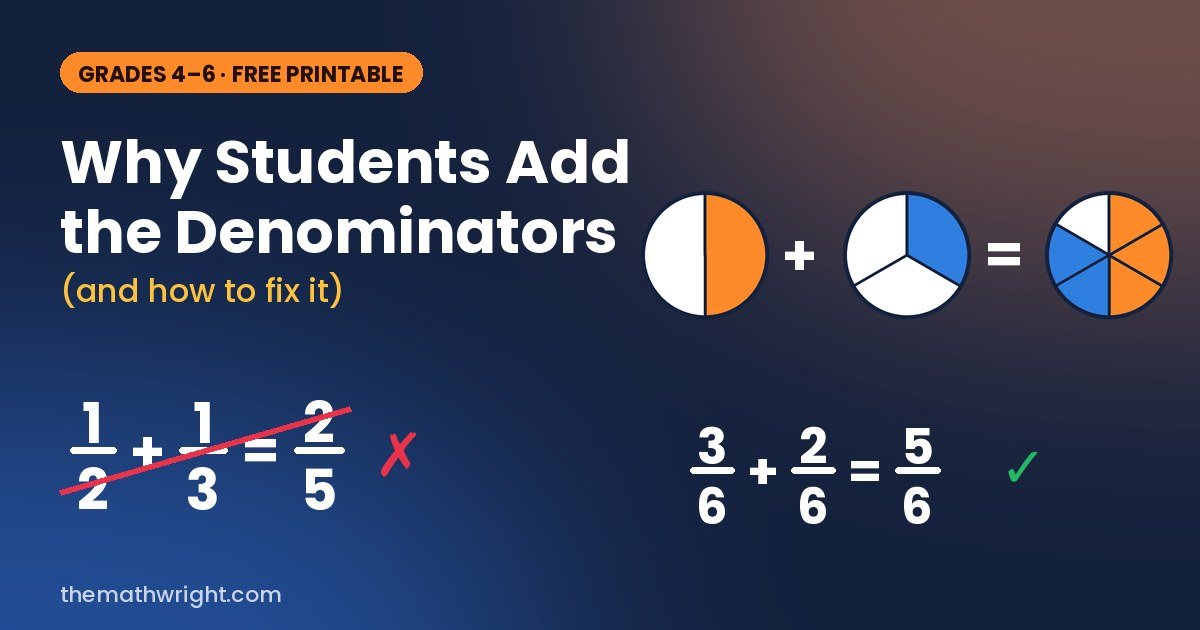
Every time I teach adding fractions, it happens. I write 1/2 + 1/3 on the board, and somebody confidently answers 2/5. Add the tops, add the bottoms, done.
If you've taught fractions, you've seen it too. The good news is that it isn't a careless mistake, and it isn't laziness. It makes perfect sense from where the student is standing, and once you see why, it's much easier to fix.
Their brains are still thinking in whole numbers
For years, students have been doing one thing with numbers: you see two numbers, you add them. 3 + 4 = 7, every time. It works, it gets rewarded, and it becomes automatic.
Then fractions arrive, and a fraction looks like two whole numbers stacked on top of each other. So students do what their brains have been trained to do: add the numbers they can see. Researchers even have a name for this: whole number bias. Students apply what's true for whole numbers to fractions, where it no longer works.
Two things make it worse:
- Multiplying fractions really does go "across". 1/2 × 1/3 = 1/6, top times top, bottom times bottom. If students learn this first, or close together, adding across feels like the same rule.
- "Keep the denominator" is often taught as a rule, not a reason. Students who memorize "add the tops, keep the bottom" without knowing why the bottom stays the same will drop the rule the moment the denominators are different.
A quick reality check shows how wrong 2/5 is. Half a pizza plus a third of a pizza is more than half a pizza. But 2/5 is less than 1/2. You added food and ended up with less. Students find that funny, and it sticks.
The real root: equivalent fractions
Adding fractions with different denominators depends completely on equivalent fractions. If a student doesn't really believe that 1/2 and 3/6 are the same amount, then changing to a common denominator is just a trick that changes the numbers for no reason.
That's why the same whole-number thinking shows up in equivalent fraction mistakes:
- 2/3 = 4/5, because "I added 2 to the top and the bottom". Adding is the whole-number habit again. To keep the same amount, you multiply (or divide) the top and bottom by the same number: 2/3 = 4/6.
- 1/3 = 3/6, because they multiplied the top by 3 and the bottom by 2. It looks close, but 3/6 is a half, not a third.
- Not seeing 3/6 as a half at all. Ask "which is bigger, 1/2 or 3/6?" and some students will pick 3/6 because 3 and 6 are bigger numbers.
If you fix the idea of equivalence, adding fractions gets much easier.
How I teach it: same denominators first, with pictures
This is the order that works for me.
Step 1: Add fractions with the same denominator, and draw them. I start with something like 1/5 + 2/5 and draw it as a pizza cut into 5 slices, or as a row of 5 boxes. Shade 1 slice, then 2 more slices. Count them: 3 slices. Each slice is still a fifth, so the answer is 3/5.
Then I ask the question that matters: "Did the slices change size?" No. We only counted more of them. That's why the denominator stays the same. The denominator tells you the size of the pieces, and the numerator tells you how many pieces you have.
Step 2: Then try different denominators, still with pictures. Now I draw 1/2 + 1/3: one pizza cut in halves, one cut in thirds. Students can see the problem right away. The pieces are different sizes, so you can't just count them together. What would "2 pieces" even mean when one is a half and one is a third?
So we cut both pizzas into the same size pieces. Halves and thirds can both be cut into sixths: 1/2 becomes 3/6 and 1/3 becomes 2/6. Now the pieces match, and we can count: 3/6 + 2/6 = 5/6.
This is the moment equivalent fractions stop being a trick. Students can see that 1/2 and 3/6 are the same amount of pizza, just cut into smaller slices.
Don't skip the number line
Pizzas and boxes are perfect for seeing parts of a whole. But they have one weakness: a picture of 3 slices out of 5 still looks like two numbers, "3" and "5". The number line fixes that. On a number line, a fraction is one number with its own place on the line, just like 2 or 0.5. That's exactly the idea whole-number thinking is missing, and it's why the Common Core asks students to place fractions on a number line from grade 3 (3.NF.A.2).
Here's how I use it for adding fractions. Draw three number lines from 0 to 1, one under the other: one split into halves, one into thirds, one into sixths.
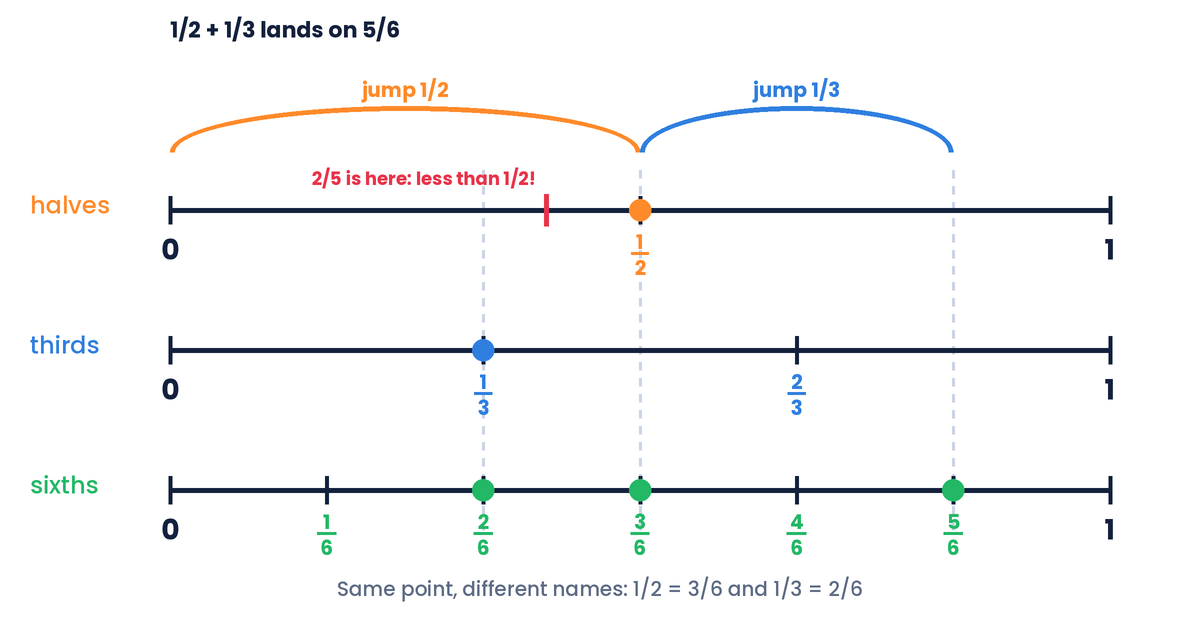
Students can see three things at once:
- Equivalent fractions are the same point with different names. 1/2 and 3/6 sit in exactly the same place, and so do 1/3 and 2/6. Nobody needs to memorize a rule.
- Adding is jumping. Start at 0, jump 1/2, then jump 1/3 more. You land on 5/6.
- 2/5 can't be right. Mark 2/5 on the line and it sits before 1/2. If you jump forward twice, you can't land behind where you started.
For extra practice, all four Mathwright games now have a Fractions on a Number Line topic. Students see a number line with a dot and pick the fraction it shows. One of the wrong answers always comes from counting the tick marks instead of the spaces, the most common number line mistake.
Two habits that stop the mistake coming back
Estimate before you calculate. Before working anything out, ask: "Will the answer be more or less than 1/2? More or less than 1?" A student who expects 1/2 + 1/3 to be a bit less than 1 will notice that 2/5 can't be right.
Find and fix other people's mistakes. Students are often much better at spotting a mistake in someone else's work than in their own. Show a worked answer like 2/5 + 1/5 = 3/10 and ask "what went wrong?" Explaining the error is what makes the correct idea stick.
Free printable: spot the mistake
These cards show 8 student-style mistakes with adding, subtracting and equivalent fractions, including all the ones in this post. Students find what went wrong and write the correct answer. The answer key shows the correct work and a short explanation of each mistake.
Free printable: Fraction Mistakes, Spot It and Fix It
8 error-analysis cards plus an answer key. Works as a warm-up, an exit ticket or a pair activity. PDF, US Letter.
Download the PDFPractice in a game
All four Mathwright games have an Adding & Subtracting Fractions topic. The wrong answer choices are built from real mistakes, including adding the denominators, so a student who still has the habit will get caught by it. At the end of the round, the Practice these list shows exactly which questions they missed.
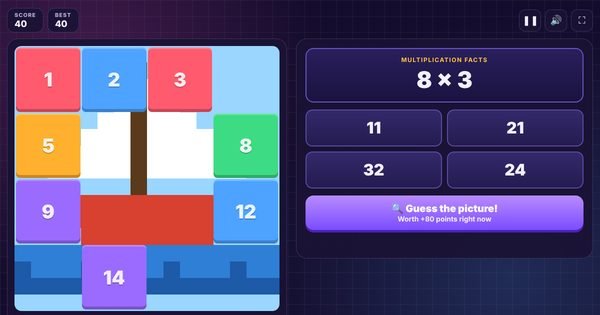
Pixel Reveal works especially well here, because it has no timer. Students who are still unsure can take their time and draw a picture if they need to.
Free game · Mystery picture
Pixel Reveal
Every right answer uncovers part of a hidden picture. Guess it early for a big bonus!
If you teach 6th grade, my Grade 6 Fractions & Decimals Workbook covers GCF and LCM (the tools for finding common denominators), dividing fractions and decimals, with complete worked solutions.
The whole-number habit took years to build, so it won't disappear after one lesson. But every time a student stops and asks "are these pieces the same size?", it gets a little weaker.