By the end of third grade, students are expected to know all products of two one-digit numbers from memory (Common Core 3.OA.C.7). That's a lot of facts, and a stack of drill worksheets is the fastest way to make kids hate them.
The good news: fact fluency doesn't need worksheets. It needs short, frequent practice that students actually want to do. Here are seven ways to get it, from zero-prep warm-ups to a free game you can project for the whole class.
1. Teach strategies before speed
Memorizing 100 separate facts is hard. Memorizing a handful of strategies is easy, and the strategies lead to the facts.
Start with the anchor facts: ×2 (doubles), ×5 (half of ×10) and ×10. Then build everything else from them:
- ×4 is double, then double again: 4 × 7 = 14 + 14 = 28.
- ×6 is ×5 plus one more group: 6 × 7 = 35 + 7 = 42.
- ×8 is double the ×4 fact: 8 × 7 = 28 + 28 = 56.
- ×9 is ×10 minus one group: 9 × 7 = 70 − 7 = 63.
Then show students that 3 × 7 is the same as 7 × 3. Once they know the ×0, ×1, ×2, ×5 and ×10 facts and the turn-around rule, only 21 facts are left to learn: the ones made from 3, 4, 6, 7, 8 and 9. That's a far less scary list.
2. Play Multiplication War
All you need is a deck of cards with the face cards removed (aces count as 1).
- Deal the deck between two players.
- Each player flips two cards and multiplies them.
- The bigger product wins all four cards.
- If the products are equal, it's war: flip two more each.
Because every round is random, students meet the hard facts over and over without noticing. For students still learning, give them a times-table chart to check with. For a challenge, play with three cards and multiply all three.
3. Build the facts with arrays
Kids who "just don't get" multiplication often have never seen what 6 × 4 looks like. Give them grid paper, counters or a mini whiteboard and ask them to build or draw the array: 6 rows of 4.
Then push it further with "Show it two ways." Can they split the 6 × 4 array into 5 × 4 and 1 × 4? That's the ×6 strategy from tip 1, made visible, and it's the same idea (the distributive property) they'll use for multi-digit multiplication later.
4. Play Buzz
A no-prep game for the last five minutes of a lesson.
The class stands in a circle and counts up one number at a time. Pick a fact family, say 7s. Any number that is a multiple of 7 must be replaced with "Buzz!" Whoever says the number by mistake, or misses a buzz, sits down. The last students standing win.
Once the class is good at it, add a second rule: buzz for 7s and "fizz" for 3s. Skip-counting this way is the step between counting and knowing the facts by heart.
5. Whiteboard showdown with missing factors
Write a fact with a gap on the board, like __ × 6 = 42, and everyone answers on mini whiteboards. On "3, 2, 1, show me!" all boards go up at once.
Missing-factor questions do double duty: they practice multiplication and division facts, because 42 ÷ 6 is the same question. You also see every student's answer in one glance, so you know exactly who needs help without anyone being put on the spot.
6. Turn it into a team battle on the board
Competition is a great motivator, as long as the whole class gets to play, not just the fastest kids.
Meteor Math is a free arcade game made for exactly this. Answers fall from the sky as meteors, and students blast the right one before it hits the city. In Team battle mode, Red and Blue take turns of 8 meteors each over 2 rounds, with points for speed and streaks so the scores stay close. Big-screen mode makes the numbers larger and the meteors slower, so students at the back can follow along.
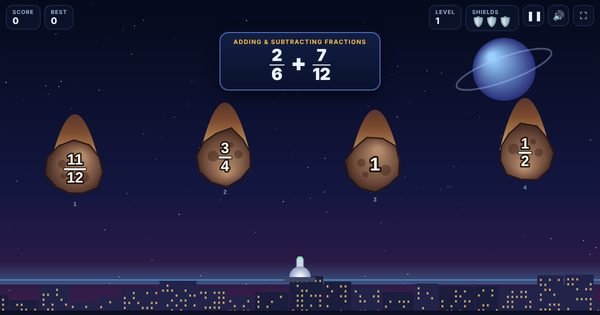
Free game · Arcade
Meteor Math
Blast the meteor with the right answer before it hits the city!
Pick the Multiplication Facts topic and a difficulty (Easy, Medium or Hard). There's no sign-up and no ads, so you can project it in seconds.
7. Track the facts each student actually misses
Most students don't need to practice the whole times table. They need to practice the four or five facts they keep getting wrong. For many kids those are facts like 6 × 7, 7 × 8 and 6 × 8.
Two easy ways to find them:
- At the end of every Meteor Math round, the Practice these list shows each missed question with its correct answer. Students can copy those facts onto a sticky note and practice just those.
- Give each student a facts tracker where they color in each fact once they know it. Seeing the chart fill up is surprisingly motivating, and the gaps show you where to focus.
Free printable: Multiplication Facts Tracker
A one-page 0–10 facts chart students color in as they learn each fact, with the strategy reminders from this post. PDF, US Letter.
Download the PDFHow much practice is enough?
Short and often beats long and rare. Five to ten minutes a day, mixing the ideas above, will do more than a 45-minute drill session on Fridays.
And keep the pressure low at first. Accuracy comes before speed: a student who gets the right answer by using a strategy is on the right track, even if it takes a few seconds. Speed follows naturally once the strategies become automatic.
Looking for a quick start tomorrow? Project Meteor Math, split the class into Red and Blue, and let them battle it out.