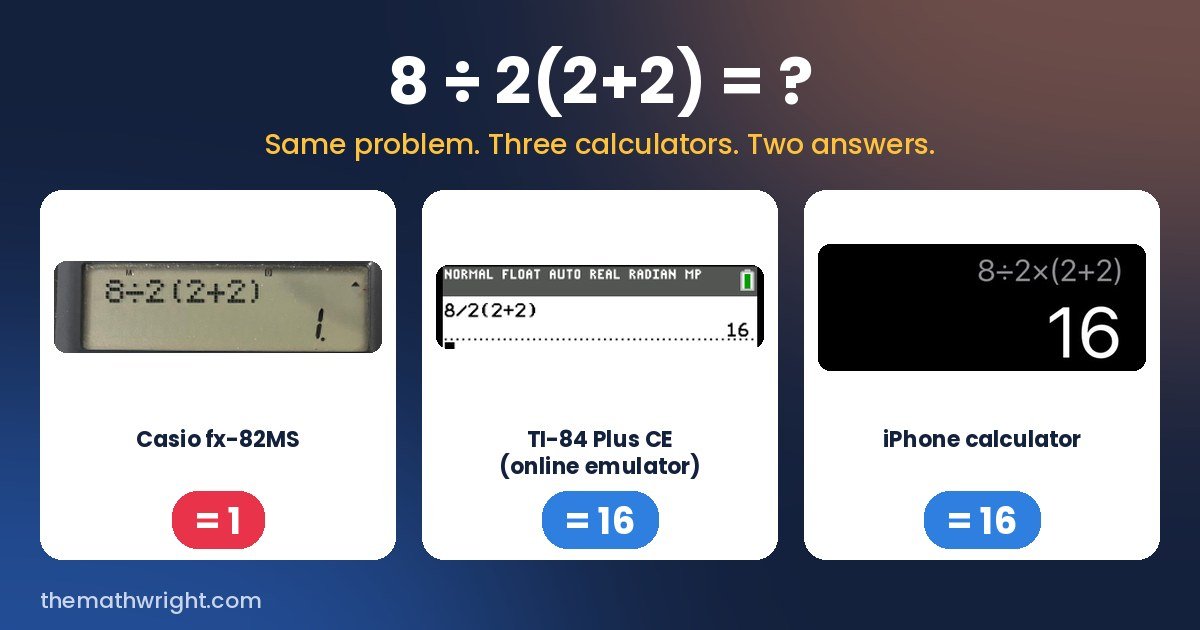
Every few months it's back. Someone posts 8 ÷ 2(2+2) with a caption like "Only 1 in 10 people get this right!" and the comments turn into a battlefield. Half the people say 16. The other half say 1. Nobody changes their mind.
I got curious, so I typed it into three calculators. The picture at the top of this post shows what happened:
- Casio fx-82MS: 1
- TI-84 Plus CE (online emulator): 16
- iPhone calculator: 16
Same problem, two answers. So who's right?
Honestly? Nobody, and that's exactly why it makes such a good lesson.
Why the calculators disagree
Let's start with the part everyone agrees on. Parentheses first: 2 + 2 = 4. That leaves
8 ÷ 2(4)
From here, there are two ways to read it.
Reading 1: left to right, answer 16. Treat 2(4) as 2 × 4. Multiplication and division have the same rank, so you go left to right: 8 ÷ 2 = 4, then 4 × 4 = 16. This is how PEMDAS is usually taught in US classrooms, and it's what the TI and the iPhone do.
Reading 2: 2(4) belongs together, answer 1. When a number is written right next to a bracket with no sign in between (this is called implied multiplication), some people and some calculators treat it as one unit. Then it's 8 ÷ 8 = 1. That's what my Casio did.
Reading 2 isn't as strange as it sounds. Write 1/2x on the board and ask your class what it means. Most people read it as 1 over 2x, not as half of x. That's implied multiplication getting priority, and we do it without even noticing.
Now look closely at the iPhone screen. I typed 8 ÷ 2(2+2), but the phone changed it to 8 ÷ 2 × (2+2). It added the × sign by itself, and with a × sign there, left to right gives 16 every time. The calculator quietly decided which problem I meant.
So what's the real answer?
The real answer is that the problem is badly written. That's not a cop-out. Once you leave elementary school, mathematicians almost never use the ÷ sign. They use fraction bars, and with a fraction bar there's nothing to argue about:
- (8 ÷ 2)(2 + 2) = 16
- 8 ÷ [2(2 + 2)] = 1
The meme only works because it hides which one it means. Good math writing never makes the reader guess, and that's a lesson worth more than either answer.
The mistake hiding behind the meme
Here's the part I care about as a teacher. A lot of people who answer 1 aren't thinking about implied multiplication at all. They learned PEMDAS as six strict steps, so they think multiplication always comes before division and addition always comes before subtraction.
It doesn't. M and D are a team: you do them together, from left to right. A and S are a team too.
- 12 ÷ 3 × 2 = 8 (not 2)
- 20 − 5 + 3 = 18 (not 12)
Plenty of students carry this mistake into middle school, and it quietly costs them points on every multi-step problem.
A 10-minute "debate the meme" warm-up
Students love being allowed to argue in math class. This warm-up uses that.
- Put 8 ÷ 2(2+2) on the board. No talking: everyone writes an answer on a mini whiteboard.
- Boards up. You'll almost certainly get both 1 and 16, and maybe a few surprises.
- Split the room by answer. Each side gets two minutes to explain their steps. The goal is to explain, not to win.
- Show the calculator photos. Watch their faces when the Casio says 1.
- Ask: "How could we rewrite this so nobody can argue?" Have students write both versions, using a fraction bar or extra brackets.
- Finish with two problems that aren't ambiguous at all: 12 ÷ 3 × 2 and 20 − 5 + 3. This is where you'll catch anyone still doing multiplication before division.
The big idea students leave with: math notation is a language, and like any language it can be written clearly or badly.
Practice that has only one right answer
Once the debate is over, students need real practice. These free warm-up cards have 12 "viral-style" problems, written so that each has exactly one correct answer. The answer key also shows the most common wrong answer for each card, so you can spot the mistake behind it.
Free printable: Order of Operations Warm-Up Cards
12 problem cards plus an answer key showing the steps and the most common wrong answer. PDF, US Letter.
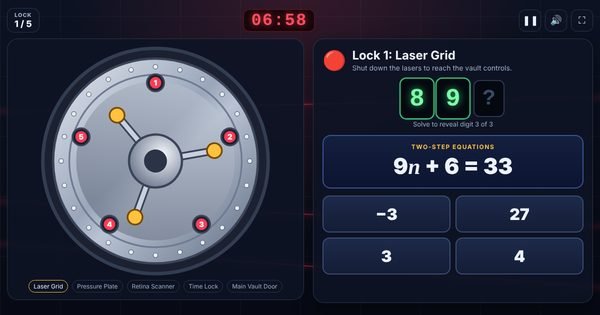
Download the PDFFor something more game-like, Escape the Vault has an Order of Operations topic. Each right answer reveals one digit of a lock's code, and wrong answers set off the alarm and cost 20 seconds. Team battle mode works really well straight after the debate, while everyone is still fired up.
Free game · Escape room
Escape the Vault
Crack 5 locks with math before the timer runs out.
If you teach 6th grade, my Grade 6 Algebra Workbook covers expressions, equations and inequalities (6.EE) with complete worked solutions and a game in every unit.
One more for your students
Want to keep the debate going? Try 6 ÷ 2(1+2) next. It's the same argument with different numbers: is it 1 or 9? This time, your students will know why both answers keep showing up.