Circle theorems are the topic my IGCSE students worry about most. The questions look like a mess of lines, and the mark scheme wants a reason for every angle, written in a particular way.
The good news: there are only 9 circle theorems you need for IGCSE and GCSE Maths, and almost every exam question uses the same few ideas again and again. In this guide you'll find all of the circle theorems with a diagram for each, the rule in plain words, the exact reason to write in the exam, and a worked example. There are practice questions with answers at the end, and a free circle theorems PDF to download.
Before you start, it helps to know a few words: a chord joins two points on the circle, a tangent touches the circle at exactly one point, and a cyclic quadrilateral has all four corners on the circle. One more fact is used in nearly every question: two radii make an isosceles triangle, so its base angles are equal.
How many circle theorems are there?
For Cambridge IGCSE (0580), Edexcel IGCSE and GCSE, there are 9 circle theorems: 6 about angles and 3 about chords and tangents (sometimes called the symmetry properties of circles). Some textbooks count them differently, for example by splitting one rule into two, but the content is the same.
The 9 circle theorems (rules and diagrams)
1. Angle in a semicircle = 90°
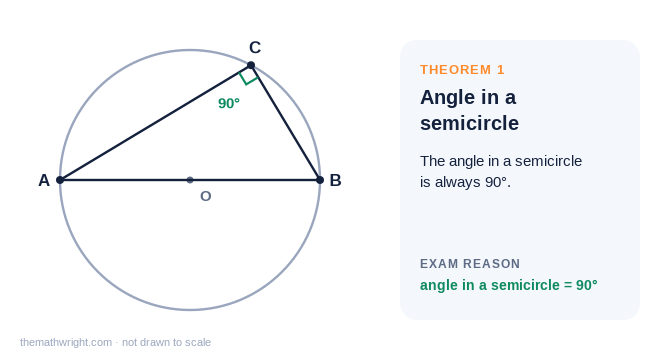
If a triangle is drawn from the two ends of a diameter to any point on the circle, the angle at that point is 90°.
Exam reason: angle in a semicircle = 90°
Example: AB is a diameter and C is on the circle. ∠CAB = 35°. Find ∠ABC.
Working: ∠ACB = 90° (angle in a semicircle), so ∠ABC = 180° − 90° − 35° = 55° (angles in a triangle add up to 180°).
2. Tangent and radius meet at 90°
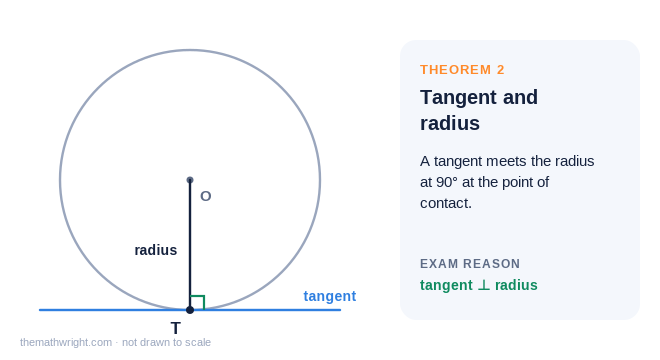
A tangent is always perpendicular to the radius at the point where it touches the circle. This one often leads to a right-angled triangle and Pythagoras.
Exam reason: tangent is perpendicular to the radius
Example: PT is a tangent at T, OT = 5 cm and PT = 12 cm. Find OP.
Working: ∠OTP = 90°, so OP² = 5² + 12² = 169 and OP = 13 cm.
3. Angle at the centre is twice the angle at the circumference
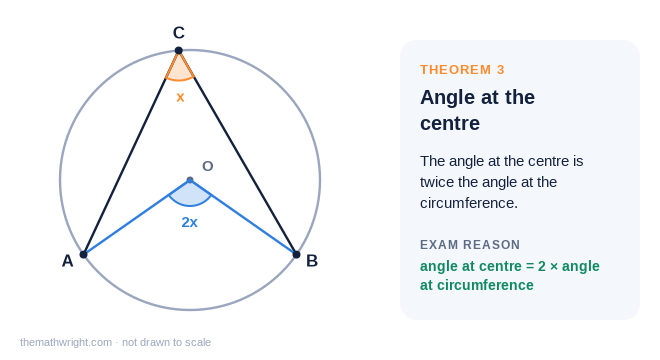
When two angles stand on the same arc, one at the centre and one at the circumference, the angle at the centre is double. Theorem 1 is actually a special case of this one: the angle at the centre is 180°, so the angle at the circumference is 90°.
Exam reason: angle at the centre is twice the angle at the circumference
Example: ∠ACB = 48° at the circumference. Find ∠AOB at the centre.
Working: ∠AOB = 2 × 48° = 96°.
4. Angles in the same segment are equal
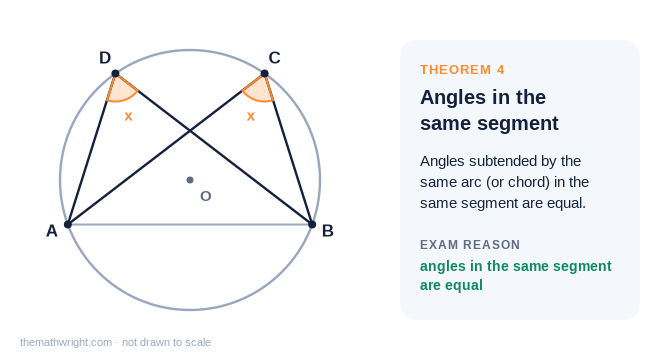
Angles at the circumference that stand on the same chord, on the same side of it, are equal. Look for a "bow tie" or "butterfly" shape.
Exam reason: angles in the same segment are equal
Example: ∠ACB = 37°. D is on the same arc as C. Find ∠ADB.
Working: ∠ADB = 37° (angles in the same segment are equal).
5. Opposite angles of a cyclic quadrilateral add up to 180°
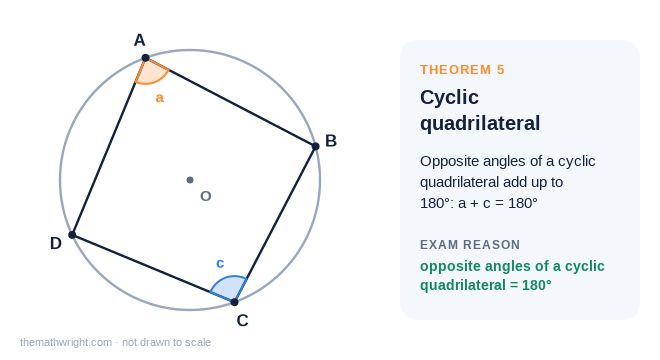
If all four corners of a quadrilateral are on the circle, each pair of opposite angles adds up to 180°.
Exam reason: opposite angles of a cyclic quadrilateral add up to 180°
Example: ABCD is a cyclic quadrilateral and ∠DAB = 112°. Find ∠BCD.
Working: ∠BCD = 180° − 112° = 68°.
6. The alternate segment theorem
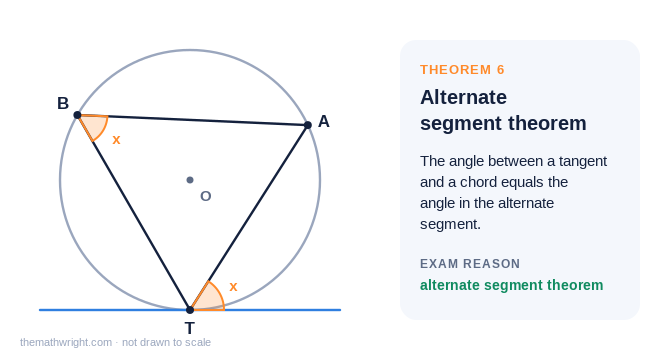
The angle between a tangent and a chord is equal to the angle in the other (alternate) segment. This is the one students find hardest to spot. Look for a tangent and a chord meeting at the same point, with a triangle drawn inside the circle.
Exam reason: alternate segment theorem
Example: The angle between the tangent at T and the chord TA is 64°. B is on the circle in the alternate segment. Find ∠TBA.
Working: ∠TBA = 64° (alternate segment theorem).
7. Equal chords are equidistant from the centre
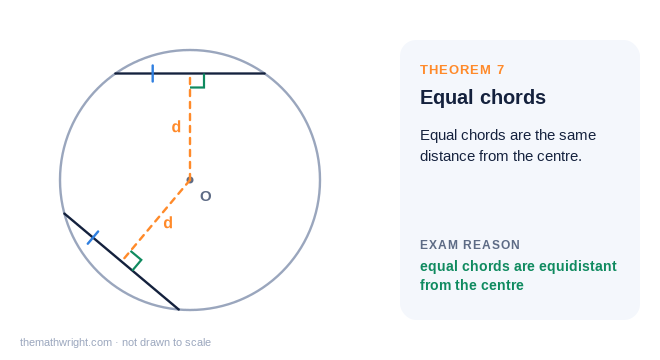
Chords of the same length are the same distance from the centre. The distance is always measured along the perpendicular from the centre to the chord.
Exam reason: equal chords are equidistant from the centre
Example: A circle has radius 10 cm. Chord AB is 16 cm long. Chord CD is also 16 cm. How far is CD from the centre?
Working: Half of AB is 8 cm, so the distance from O to AB is √(10² − 8²) = √36 = 6 cm. CD is the same length, so it is also 6 cm from the centre.
8. The perpendicular bisector of a chord passes through the centre
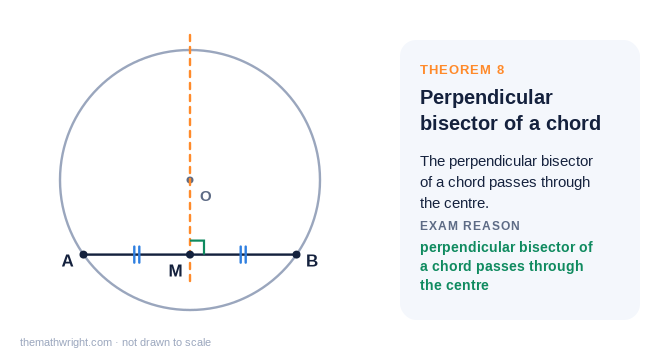
The line that cuts a chord in half at 90° always goes through the centre. It works the other way too: a line from the centre perpendicular to a chord cuts the chord in half.
Exam reason: the perpendicular bisector of a chord passes through the centre
Example: Chord AB is 24 cm long and 5 cm from the centre O. Find the radius.
Working: M is the midpoint of AB, so AM = 12 cm and ∠OMA = 90°. OA² = 12² + 5² = 169, so the radius is 13 cm.
9. Tangents from an external point are equal
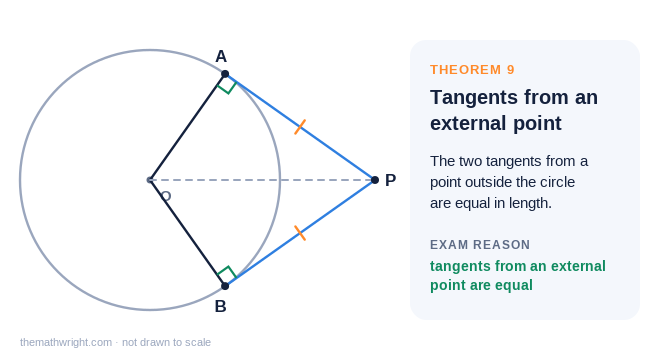
From any point outside a circle you can draw exactly two tangents, and they are the same length. That makes triangle PAB isosceles, and OAPB is a kite with two right angles.
Exam reason: tangents from an external point are equal in length
Example: PA and PB are tangents and ∠APB = 50°. Find ∠AOB.
Working: ∠OAP = ∠OBP = 90° (tangent and radius), and the angles in quadrilateral OAPB add up to 360°. So ∠AOB = 360° − 90° − 90° − 50° = 130°.
Circle theorems cheat sheet
Here are all the circle theorems on one list, with the reason to write in the exam:
- Angle in a semicircle = 90°.
- Tangent ⊥ radius: a tangent meets the radius at 90°.
- Angle at the centre = 2 × angle at the circumference.
- Angles in the same segment are equal.
- Opposite angles of a cyclic quadrilateral add up to 180°.
- Alternate segment theorem: angle between tangent and chord = angle in the alternate segment.
- Equal chords are equidistant from the centre.
- Perpendicular bisector of a chord passes through the centre.
- Tangents from an external point are equal in length.
5 common circle theorem mistakes
- Using the semicircle rule without a diameter. The angle is only 90° if the chord goes through the centre. Check for O on the line.
- Halving the wrong way. The angle at the centre is the bigger one. If you find the angle at the circumference, double it to get the centre, not the other way round.
- Calling a shape cyclic when it isn't. If one corner of the quadrilateral is at the centre O, it is not a cyclic quadrilateral. All four corners must be on the circle.
- Missing the isosceles triangle. Any triangle with two radii as sides (for example OAB) is isosceles. Many questions can't be finished without it.
- Mixing up the alternate segment. The equal angle is on the other side of the chord from the tangent angle. Trace the chord with your finger, then look across it.
Circle theorems questions (with answers)
Try these exam-style circle theorems questions. O is always the centre of the circle. The answers are below.
- AB is a diameter and C is on the circle. ∠ABC = 28°. Find ∠BAC.
- A, B and C are on the circle, with C on the major arc. ∠AOB = 140°. Find ∠ACB.
- ABCD is a cyclic quadrilateral. ∠ABC = 3x and ∠ADC = 2x + 30°. Find x.
- PA and PB are tangents from P, touching the circle at A and B. ∠APB = 40°. Find ∠OAB.
- A chord is 10 cm long and 12 cm from the centre. Find the radius of the circle.
- The tangent at T makes an angle of 72° with the chord TB. A is on the circle in the alternate segment. Find ∠TAB.
Answers
- 62°. ∠ACB = 90° (angle in a semicircle), so ∠BAC = 180° − 90° − 28° = 62°.
- 70°. Angle at the centre = 2 × angle at the circumference, so ∠ACB = 140° ÷ 2 = 70°.
- x = 30°. Opposite angles of a cyclic quadrilateral add up to 180°: 3x + 2x + 30 = 180, so 5x = 150 and x = 30. (So ∠ABC = 90° and ∠ADC = 90°.)
- 20°. Tangents from an external point are equal, so triangle PAB is isosceles and ∠PAB = (180° − 40°) ÷ 2 = 70°. ∠OAP = 90° (tangent ⊥ radius), so ∠OAB = 90° − 70° = 20°.
- 13 cm. The perpendicular from the centre bisects the chord, so half the chord is 5 cm. r² = 5² + 12² = 169, so r = 13 cm.
- 72°. Alternate segment theorem.
Free circle theorems PDF
Want all of this in one place to print or revise from? My free circle theorems notes cover all 9 theorems with diagrams, worked examples and exam tips, plus 35 past paper questions with full solutions from Cambridge IGCSE 0580 Papers 1–4.
Free PDF: Circle Theorems notes and exam practice (IGCSE 0580)
All 9 circle theorems, worked examples, a one-page summary and 35 solved past paper questions. 31 pages.
Download the PDFYou'll find more free IGCSE notes, including angles (which circle theorem questions build on) and mensuration, on the free IGCSE Maths notes page.
Need help with circle theorems?
If circle theorems still feel confusing, a short one-to-one session usually fixes it fast. I teach IGCSE Maths (Cambridge 0580 and Edexcel) online, and the first 40-minute class is free. Book a free demo class.